
Ozirma - Spectrometer for sorting plastic
Background
Ozirma consists of a small infrared spectrometer capable of sorting the different types of plastic. The challenge is to facilitate local and autonomous recycling of plastic waste.
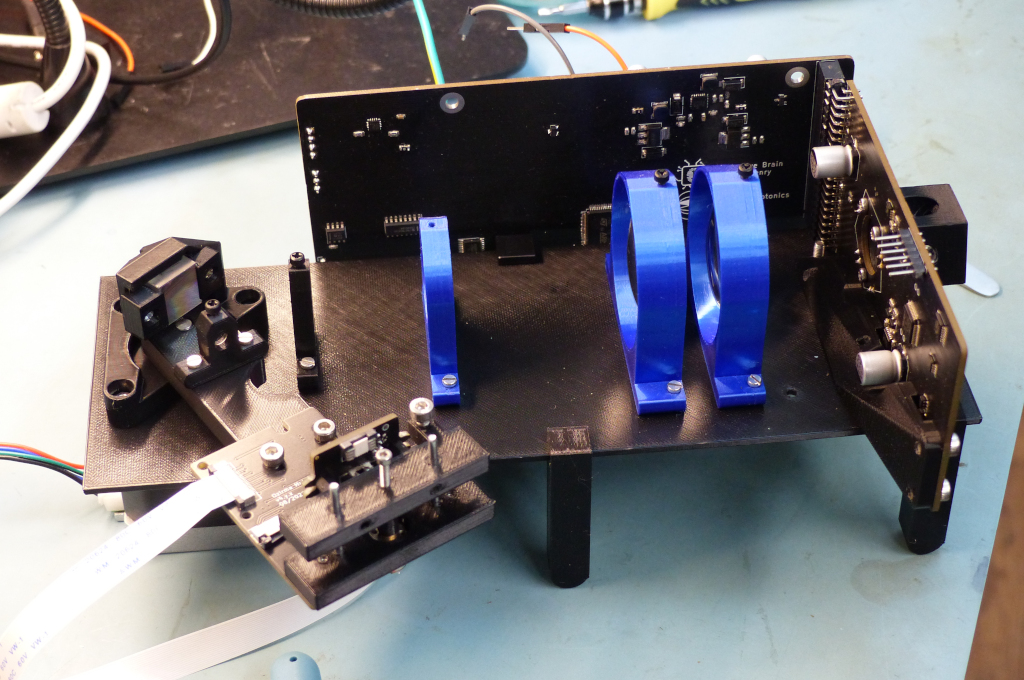
I have been carrying this project since January 2019, with Mejdi NCIRI, Optical Engineer. He created his structure Impact Photonics.
Beyond the engineering challenges (optical, mechanical, electronic) it represents, the originality of the project is to meet basic socio-economic needs: - Frugal design: BOM ("Bill Of Material": manufacturing cost excluding labour and logistics) less than €200 - Manufacturing compatible with Fablabs technologies: 3D printing, laser cutting, CMS electronics, digital milling, thermoforming. - Hardware and open-source firmware: everyone is free to copy, repair, improve, modify. - Spectral databases and open-source analysis algorithms: system sustainability and quality assurance
Only 10% of plastic waste is recycled today. Sorting used plastic is the first step in recycling.
Large recycling centres use a very efficient sorting method based on very fast but very expensive infrared spectrometers (100k€+). Small, decentralized structures use qualitative manual methods that do not allow for the efficient sorting of all types of plastics or small shrapnel.
No product exists today to sort plastic on a small scale and at very low cost.
In recent years, several projects have emerged aimed at democratizing technologies for the recovery of plastic waste on a smaller scale and at a lower cost; for example the [Precious Plastic] community(https://precious-plastic.org) or the shipping Plastic Odyssey.
A low-cost sensor would allow these projects - as well as small workshops, fablabs and makers - better sorting and recycling plastics.
Operation
The various plastics are recognizable in infrared. That is, their spectrograms will be different, between 1000nm and 1700nm.
These wavelengths are not visible to the naked eye. But recognizable with a deceitful material.
Contrary to how conventional spectrometers work, with a photodiode "array", we decided, to optimize the cost of BOM, to have only one sensor (a photodiode) and to move it along the spectrum.
Internally, we will find the entire chain of a spectro:
- Light sources (LEDs at 950nm, 1200nm, 1400nm, and 1650nm)
- Reflection on sample
- Switching into lenses
- Switching into a hole to reduce beam diameter
- Switching over the diffraction network
- and the sensor, mounted on an axis of rotation, the angle of the sensor thus gives the measurement to a given length.
(I am not specialized in optics so this description will make the pros jump ;)
and electronic side: - PDM-controlled power sources (for LEDs) - Steering of step-by-step engines (for measuring angle, and compensation in H) - Measurement: via a transimpedance amp (TIA) designed internally, - 1GOhm gain - ~1kHz bandwidth - and Acquisition via an ADC.
The whole is controlled by several electronic cards, with USB communication.
Internal software allows you to configure and communicate with hardware and make measurements...
Project status
The project has been on a break for a while, for lack of time (means!)
BUT: We have managed to make measurements close to reality, on PS and PVC:

We have launched a part-financing campaign that has not been fully completed, with a first milestone of cleaning up and liberating sources.
However, we propose the sources here: